
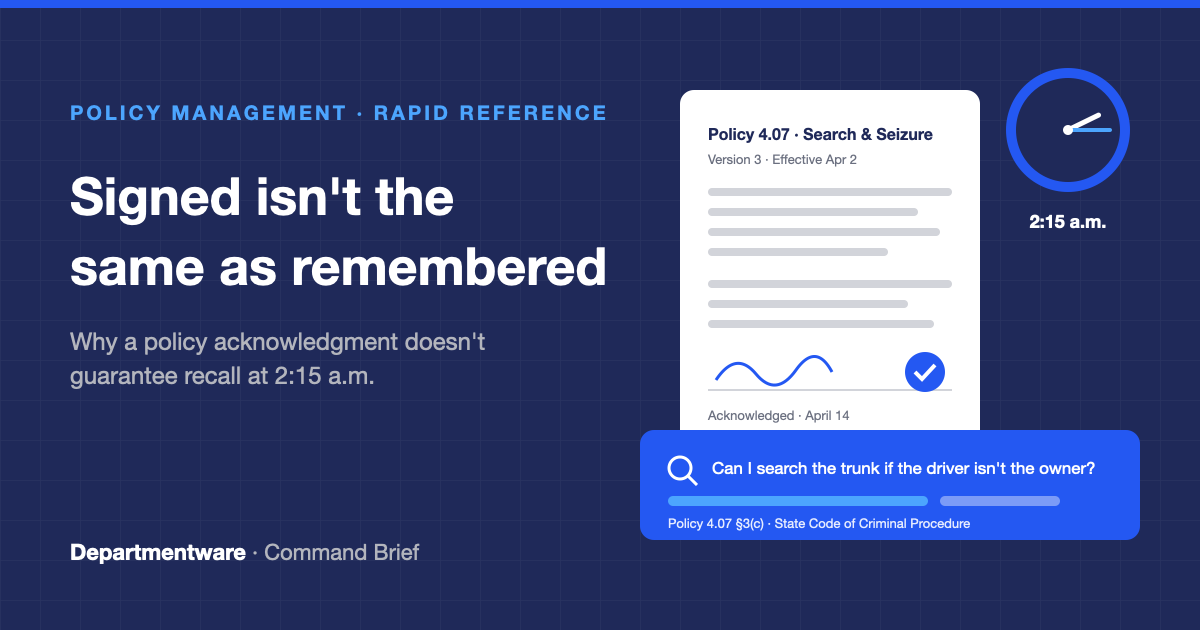
Short answer: A policy acknowledgment proves that an officer received and reviewed a specific version of a policy on a specific date. It does not prove the officer will remember a particular rule months later, under pressure. Agencies need both: an audit-ready sign-off record, and a fast way for employees to look up the exact policy language when a decision comes up.
It's 2:15 a.m. An officer has a car stopped for a moving violation, and the encounter starts heading toward a possible search. The officer remembers the training. They know the search policy exists, and they know they signed it back in the spring.
What they don't remember, at least not with full confidence, is one detail. Does department policy add a restriction on top of the legal standard? Does this situation require a supervisor notification? What has to go in the report?
The answer is in the building somewhere. Part of it is in the general orders, part in the state code of criminal procedure, part in a training bulletin from last year. The signed acknowledgment from April doesn't help much right now.
That gap, between “signed” and “remembered,” is one most command staffs know about and few have a plan for.
What does a policy acknowledgment actually prove?
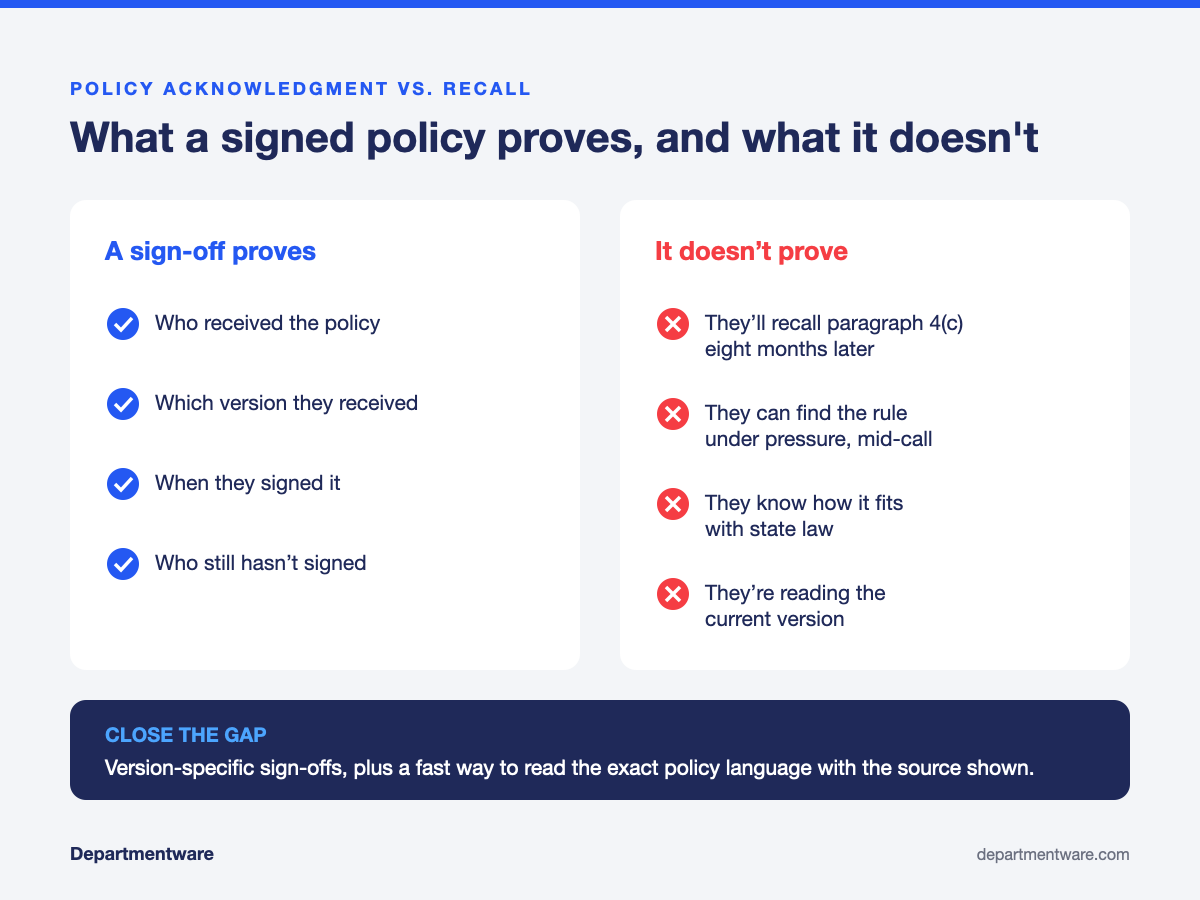
A good acknowledgment record answers four questions:
- Who received the policy
- Which version they received
- When they signed it
- Who still hasn't signed it
That record matters a lot. After a critical incident, an attorney, a review board or an accreditation assessor will ask which version of a policy was in force and whether the officer had it. If you can't answer that cleanly, you're in a weak spot before anyone talks about the facts of the case.
But think about what a signature is. It's a statement that a person read something. It says nothing about whether they'll recall paragraph 4(c) in eight months, after hundreds of calls and a dozen other policy updates in between.
Nobody in policing actually believes officers memorize the manual. Between agency policy, general orders, state statutes, municipal ordinances and federal requirements, the volume of written guidance an officer is accountable for is enormous. Expecting perfect recall isn't a standard. It's a hope.
Why does this gap matter to command staff?
Three reasons.
It's an officer safety and decision-quality issue
Rules that come up rarely are the ones most likely to be forgotten and the ones most likely to matter when they do come up. An infrequent exception to a pursuit policy. A notification requirement for a juvenile contact. An evidence-handling step for a specific item type.
It's a liability issue
After an incident, “the officer signed the policy” is only half an answer. Reviewers increasingly ask what the agency did to make the policy usable in the field. A policy that lives in a 400-page PDF on a shared drive is technically available. Practically, it isn't.
It's a fairness issue
If an officer makes a call that breaks a rule they couldn't reasonably have looked up in the moment, you end up disciplining a memory lapse. That's corrosive to trust inside the department, and officers notice.
It's not just patrol
The same gap shows up everywhere in an agency. In every role, the agency has already written the guidance down. The problem is getting to the right paragraph quickly.
| Role | Typical lookup |
|---|---|
| Patrol officer | Search and seizure restrictions, pursuit rules, juvenile contact procedures |
| Telecommunicator | Notification procedures for unusual calls, call-handling SOPs |
| Detention officer | Intake requirements, classification and housing rules |
| Evidence / forensics tech | Handling, packaging and chain-of-custody steps |
| Supervisor | Which policy version applied on a given date, required follow-up after an incident |
Why “just search the PDF” doesn't work
Most agencies do give employees a searchable manual. The trouble is that keyword search assumes you already know three things: which document to open, which words the author used, and which of the 40 hits is the one that matters.
A question like “Can I search the trunk on a consent search if the driver isn't the owner?” usually touches at least two sources: agency policy and state law. Keyword search makes the employee find and read each one separately, then reconcile them, while standing next to a car.
How agencies close the gap
There's no single fix, but the agencies that handle this well tend to do the same handful of things.
Keep acknowledgments version-specific
Every sign-off should be tied to a specific version of the policy, with a date and timestamp. When a policy changes, the new version goes back out for signature. This is the job of policy management software, and it's the foundation for everything else.
Explain what changed, not just that something changed
A revision notice that says “Policy 3.12 updated” teaches nobody anything. A two-line summary of the actual change does.
Train on the rare stuff
Daily procedures get reinforced by repetition. The exceptions and low-frequency rules need deliberate refreshers in roll call and in-service.
Give people a way to look things up in plain language
Let employees ask a question the way they'd ask a sergeant and get pointed to the exact passages in the agency's own policy and the relevant law.
Always show the source
A summary without a citation creates a new problem. The employee needs to see the actual policy language, including the conditions and exceptions, before acting on it.
Keep the reference library current
If the policy changed but the old training manual is still in the search results, you've built a tool that confidently points people at outdated guidance.
Where Departmentware fits
Departmentware handles both sides of this.
Policy Management distributes policies, tracks sign-offs by version, date and user, flags who hasn't signed, and keeps a full version history. That's the audit record.
Rapid Reference handles the lookup. An employee types or dictates a question on a phone or a computer, and Rapid Reference searches the agency's loaded library: policies, general orders, training manuals, state penal code, code of criminal procedure, municipal ordinances, detention procedures. It returns the relevant passages with the source document named and the supporting text highlighted, so the employee reads the real language rather than a paraphrase.
Back at the 2:15 a.m. traffic stop, when there's a safe moment, the officer asks the question, reads the search policy passage and the matching state law side by side, and calls a supervisor if it's still unclear. Rapid Reference doesn't make the decision. It gets the officer to the guidance the agency already expects them to follow.
A few practical details agencies usually ask about:
- Rapid Reference is included at no extra cost for every Departmentware partner, whichever applications you subscribe to. You don't need Policy Management to use it.
- Our team helps load your initial reference manuals.
- It's used for more than 2,000 searches a day across Departmentware agencies.
Want to see how the workflow could fit your agency? Request a demo.
The question to bring to your next staff meeting
You almost certainly have good acknowledgment records. The harder question is this one: when one of your officers needs a specific rule at 2:15 a.m., how long does it take them to find it, and how sure are they that it's the current version?
If the honest answer is “It depends who you ask,” that's the gap.
Frequently asked questions
What is a police policy acknowledgment?
A policy acknowledgment is a recorded confirmation, usually a digital signature with a timestamp, that an employee received and reviewed a specific version of an agency policy. It's used for accountability, accreditation and legal defense.
Is a signed policy acknowledgment enough to defend an agency in court?
It's necessary but usually not sufficient on its own. Reviewers also look at whether the policy was clear and current, whether related training was delivered, and whether supervisors enforced it consistently. This is general information, not legal advice; consult your agency's counsel.
How often should officers re-acknowledge policies?
At minimum, every time a policy is materially revised. Many agencies also run an annual re-acknowledgment cycle for high-risk policies such as use of force, pursuits and search and seizure.
Can AI tools give officers legal advice in the field?
No, and they shouldn't try. A tool like Rapid Reference searches the agency's own approved documents and shows the source passages. It doesn't replace policy, legal counsel, supervisor direction or the officer's judgment.
What's the difference between policy management software and an AI policy search tool?
Policy management software handles distribution, version control and sign-off tracking. An AI policy search tool helps employees find the right passage in those policies (and in related laws) when they need it. One documents review. The other supports decisions during the workday.