
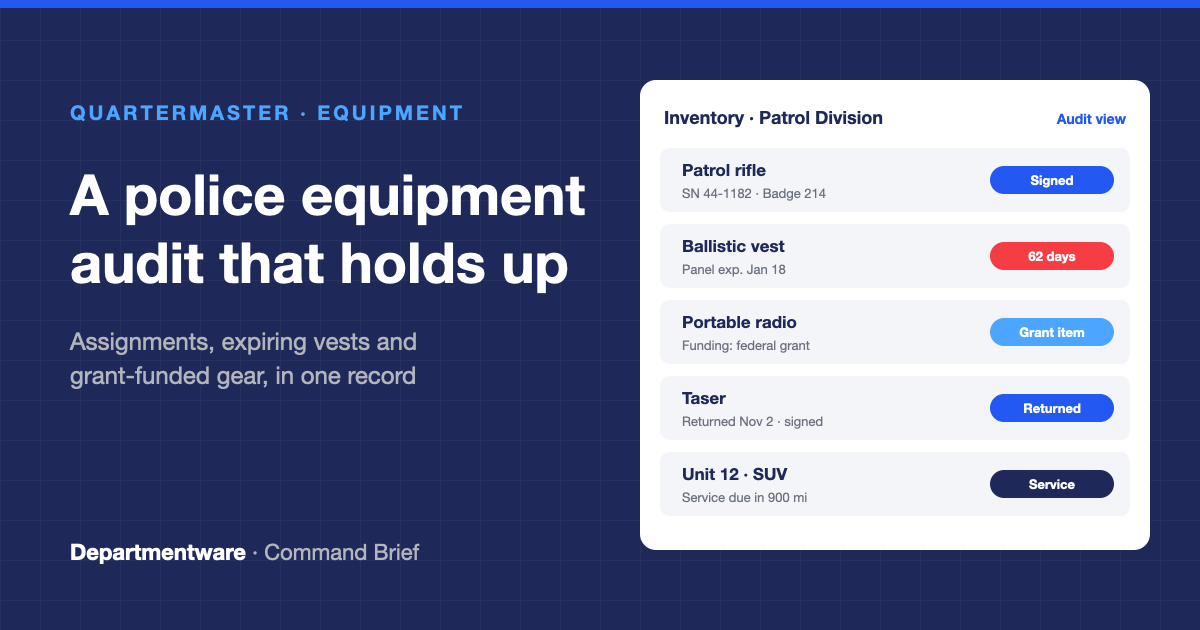
Short answer: A police equipment audit checks that every item the agency owns, from radios and rifles to vests and vehicles, is where the records say it is, assigned to the right person, in usable condition and within its service life. To pass one without a scramble, agencies need a single inventory record per item, signed assignments, expiration alerts and a clear trail for anything bought with grant money.
Police inventory software gives quartermasters one current record for each item, so an audit can start with a reliable list instead of a collection of spreadsheets and hand receipts.
Ask any quartermaster about their worst audit and you'll get a story. Usually it involves a spreadsheet with three versions, a box of radios nobody can match to serial numbers, and an officer who retired two years ago and may or may not have turned in a rifle.
None of that is unusual. Equipment tracking in a lot of agencies grew up one piece at a time: a spreadsheet for weapons, a binder for uniforms, the fleet sergeant's own system for vehicles, and a desk drawer full of signed hand receipts. It works until somebody asks a hard question.
The hard question usually arrives as one of these:
- A federal grant monitor wants to see every item bought with last year's award.
- A vest fails, and someone asks how old it was.
- An officer leaves, and you need a list of everything they were issued.
- The city's finance office wants the replacement cost of the fleet for next year's budget.
If answering any of those takes more than a few minutes, the audit is going to hurt.
What should a police equipment audit cover?
At minimum, every serialized or high-value item should have answers to these questions:
| Question | Why it matters |
|---|---|
| What is it? (description, make, model, serial) | You can't audit what you can't uniquely identify |
| Where is it right now? | Physical location, or the person it's issued to |
| Who signed for it, and when? | Accountability if it's lost or damaged |
| What condition is it in? | Damaged gear in service is a safety and liability problem |
| When does it expire or need service? | Vests, plates, OC spray, AED pads, vehicle maintenance |
| How was it paid for? | Grant-funded items carry extra record-keeping rules |
| What did it cost, and when will it need replacing? | Budget planning |
| What happened to it at end of life? | Disposal, transfer, destruction, sale |
Most agencies track the first two pretty well. The gaps tend to show up in the last four.
Grant-funded equipment has its own rules
This is the part that catches agencies out.
If equipment was bought with federal grant money, the federal Uniform Guidance at 2 CFR 200.313 sets minimum property management requirements. In plain terms, your records need to include the item's description, serial or ID number, funding source, who holds title, acquisition date, cost, the federal share of the cost, location, use and condition, and eventually how it was disposed of. The rule also requires a physical inventory, reconciled against the records, at least once every two years.
That's a lot of fields to keep straight in a spreadsheet, especially when the same model of radio was bought partly with general fund money and partly with a grant. When the monitor asks “Show me where every item from this award is today,” you need to be able to filter by funding source and get a list, not start a phone tree.
State grant programs often have their own requirements on top of this, so check your award terms.
Expiring gear is a safety issue, not just a paperwork one
Some equipment doesn't fail loudly. It just quietly stops being reliable.
Body armor
Most manufacturers warranty ballistic panels for five years. The National Institute of Justice publishes the performance standards that armor is tested against. Agencies that buy vests through the Bureau of Justice Assistance's Patrick Leahy Bulletproof Vest Partnership also have to keep a mandatory wear policy in place.
Plates and carriers
Same logic, separate expiration dates.
OC spray, medical supplies, tourniquets and AED pads
All carry expiration dates printed on the item and nowhere else unless you record them.
Vehicles
Expiry here means service intervals, inspections and registration.
The fix is simple to describe and tedious to do by hand: record the expiration date when the item comes in, and get an alert well before it lapses. Sixty to ninety days out gives you time to order replacements without a gap.
Signed assignments save arguments later
When an officer is issued a rifle, a radio and a set of keys, they should sign for each item, and that signature should be tied to a date and time. When they turn the items back in, the return should be recorded the same way.
That sounds like bureaucracy until the day an item goes missing. Then the signed record is the difference between a five-minute conversation and a week-long investigation. It also protects the officer: if they turned the item in, the record shows it.
Grouping people helps here too. SWAT, detention and patrol carry different kits. If you can assign equipment and run checks by group, a quarterly SWAT kit inspection becomes one filtered list instead of thirty separate lookups.
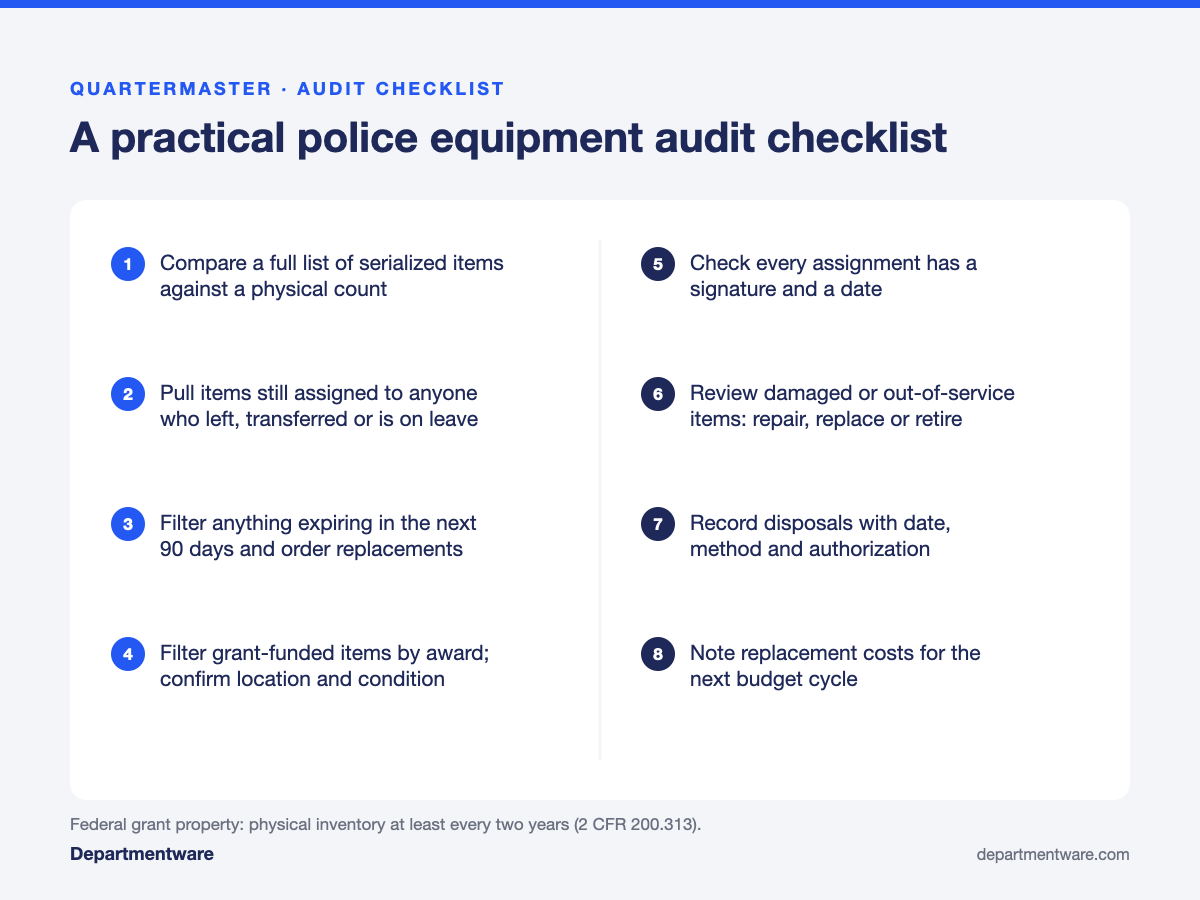
A practical audit checklist
Use this before a scheduled audit or as a quarterly self-check.
- Export a full list of serialized items and compare it against a physical count, location by location.
- Pull every item assigned to someone who has left the agency, transferred or gone on extended leave.
- Filter for anything expiring in the next 90 days and order replacements.
- Filter grant-funded items by award and confirm each one's location and condition.
- Check that every assignment has a signature and a date.
- Review items marked damaged or out of service, and decide: repair, replace or retire.
- Record disposals properly, with date, method and authorization.
- Note the replacement cost of anything nearing end of life, for the next budget cycle.
If steps 1 through 4 each take an afternoon, your records are in reasonable shape. If they each take a week, the problem is the system, not the people.
Where Departmentware fits
Quartermaster is Departmentware's inventory software for law enforcement. It was built around the audit questions above. Intel Forms can support the associated field documentation, and you can request a demo when you're ready to see the workflow.
- One record per item, from uniforms and weapons to technology and specialized gear
- Digital sign-offs on assignments, with a date and time stamp on every issue and return
- A list of everything assigned to each user, available in seconds
- Expiration tracking and alerts for items like OC spray, vests and plates
- A grant funding option that shows where every grant-purchased item is at any time
- Lifecycle tracking from procurement through disposal
- Fleet assignment, maintenance schedules and service history
- Cost tracking for budget planning
- User groups such as SWAT, Jailers or Patrol for group-level tracking
Agencies in more than 36 states use Departmentware. Many start with Quartermaster because the pain is so concrete: the next audit date is on the calendar.
The short version
An equipment audit is really testing one thing: whether your records match reality. Agencies that pass easily aren't more organized people. They just keep one record per item, get a signature for every handoff, write expiration dates down when gear arrives, and can filter by funding source. Everything else follows from that.
Frequently asked questions
What is police inventory software?
Police inventory software tracks an agency's equipment, such as weapons, radios, body armor, uniforms, technology and vehicles, in one system. It records who each item is assigned to, where it is, its condition, its cost, its expiration or service dates and how it was funded.
How often should a police department audit its equipment?
For property bought with federal grant funds, 2 CFR 200.313 requires a physical inventory at least once every two years. Many agencies audit high-risk items such as firearms more often, often annually or quarterly, under their own policy or accreditation standards.
How long does police body armor last?
Most manufacturers warranty ballistic panels for five years. Agencies should record each vest's manufacture and issue dates and replace it according to the manufacturer's warranty and agency policy.
What records are required for grant-funded police equipment?
Under the federal Uniform Guidance, records should include a description, serial or ID number, funding source, title holder, acquisition date, cost, federal share, location, use and condition, and disposition data. Check your specific award terms, as state and program rules can add requirements.
What happens to equipment when an officer leaves the agency?
The agency should pull a list of everything assigned to the officer, collect each item, and record each return with a date and signature. Any missing items should be documented and handled under agency policy.
Disclaimer: The Command Brief is intended to provide operational analysis and strategic preparedness insights for public safety leadership. Content is informational only and should be evaluated in accordance with applicable laws, policies, and agency-specific operational requirements.