
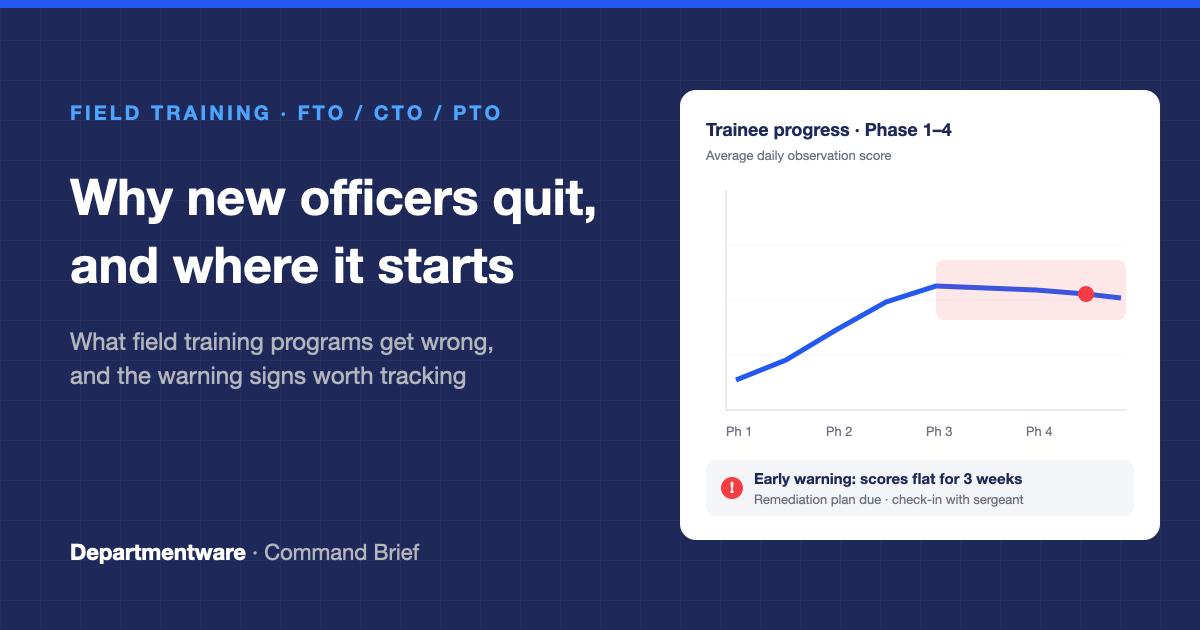
Short answer: Many officers who resign in their first two years start pulling away during field training. The common causes are inconsistent trainers, slow or unclear evaluations, paperwork overload and supervisors who disappear after the academy. Agencies that keep more recruits treat field training as development rather than a filter, document progress as well as problems, and watch for early warning signs across the whole program.
A field training officer program is the first sustained test of whether the agency's standards, coaching and support match what a new officer was promised during recruiting.
Recruiting a police officer is expensive. Between the hiring process, background checks, the academy and months of paid field training, an agency has made a big bet on every recruit by the time they ride solo.
So it stings when that officer resigns eighteen months later. And it stings more when the exit interview, if there is one, doesn't say much. “Better opportunity.” “Personal reasons.” “Not the right fit.”
In most cases, the real story started much earlier, and a lot of it happened in the patrol car with a field training officer.
Resignations rarely happen suddenly
Very few officers quit over one bad day. What usually happens is slower. A trainee gets three different trainers with three different standards. Daily observation reports come back a week late. The feedback is all about what went wrong. A sergeant they met once at graduation never checks in. The trainee spends evenings catching up on policy sign-offs and certification paperwork.
None of those things is a crisis on its own. Stacked up over six months, they tell a new officer something about the agency: that nobody is really paying attention to whether they make it.
By the time a resignation letter shows up, the decision was often made a long time ago.
Where field training programs tend to go wrong
These are the patterns that come up again and again when agencies look back at early resignations.
Inconsistent trainers
One FTO is a gentle coach, the next is a hard-liner, the third is burned out and counting the days. Trainees end up learning the trainer, not the standard. If the program can't show that a “3” in report writing means the same thing on day shift and night shift, it isn't really a standard.
Late or vague evaluations
A daily observation report that arrives a week after the shift is close to useless as coaching. So is one that says “needs improvement” without saying what or how.
Documentation that only records failures
If the paperwork captures every mistake and none of the progress, the trainee reads it as a case being built against them. Good programs document improvement too.
Remediation without a plan
Telling a trainee they're behind isn't remediation. Remediation is a specific skill gap, a specific plan and a date to check again.
Supervisors who vanish
Trainees judge the agency by the people closest to them: their FTOs, their corporal, their sergeant. When supervisors only show up for problems, new officers notice.
Administrative overload
Field training is already demanding. Add policy acknowledgments, certification tracking, scheduling changes and duplicate data entry across disconnected systems, and a trainee can feel behind all the time without ever doing anything wrong on the street.
Early warning signs worth tracking
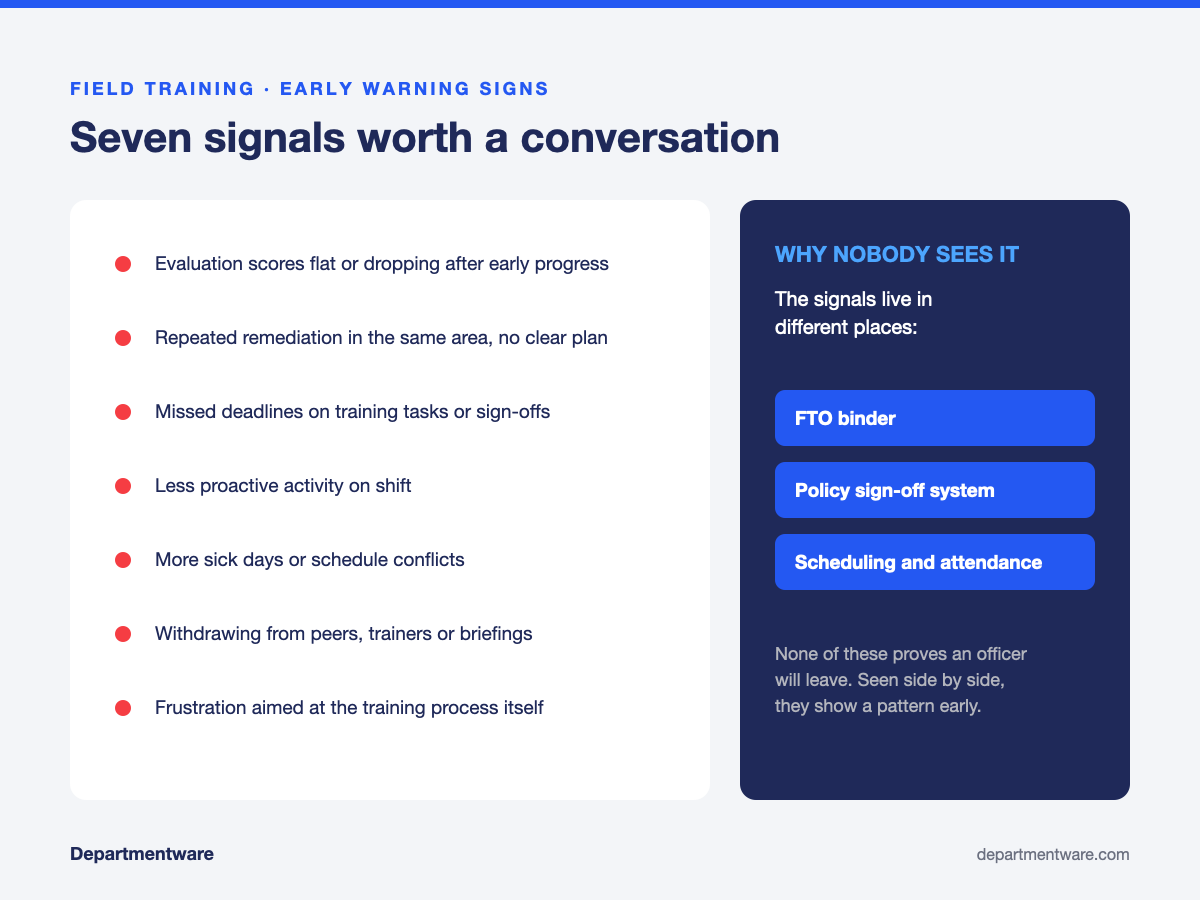
None of these proves an officer is about to leave. Together, they're worth a conversation.
- Evaluation scores flat or dropping after early progress
- Repeated remediation in the same area without a clear plan
- Missed deadlines on training tasks or sign-offs
- Less proactive activity on shift
- More sick days or schedule conflicts
- Withdrawing from peers, trainers or briefings
- Frustration aimed at the training process itself
The catch is that these signals usually live in different places. Scores are in the FTO binder, sign-offs in the policy system, attendance in scheduling. Nobody sees them side by side, so nobody sees the pattern.
Which field training model should you use?
There isn't one right answer, and the model matters less than how consistently you run it. The common options:
| Model | Origin | How it works |
|---|---|---|
| San Jose FTO model | San Jose Police Department, early 1970s | Phased training with daily observation reports (DORs) scored against standardized evaluation guidelines. Still the most widely used model in the US. |
| Reno PTO model | Reno Police Department and PERF, late 1990s, with COPS Office funding | Problem-based learning. Trainees work through real community problems and are assessed on how they solve them, with less emphasis on daily scores. |
| Hybrid or custom | Agency-specific | Many agencies blend daily evaluations with problem-based tasks, or adapt a model for communications (CTO), detention (JTO) or EMS training. |
Whatever you choose, write the standard down, train your FTOs on it, and make sure the paperwork reflects it.
What agencies that retain officers do differently
Coach first, filter second
Field training still has to wash out people who aren't suited to the job. But the default assumption should be that a recruit the agency hired can be developed.
Get evaluations out the same shift
Feedback is most useful while the call is still fresh. Digital daily observation reports make same-day sign-off realistic.
Record progress, not just problems
A note that a trainee handled a tense domestic call well is worth writing down. It's also useful evidence if the trainee later needs remediation in another area.
Make remediation specific
Name the skill, set the plan, set the check-in date and document the result.
Keep supervisors in the loop
Sergeants and lieutenants should be able to see every trainee's progress without asking for a binder.
Cut the administrative friction
If a trainee has to enter the same data in three systems, fix the systems.
Look at the program, not just the trainees
If one FTO's trainees consistently score lower or leave more often, that's a program issue, not a recruit issue.
Where Departmentware fits
Departmentware's FTO / CTO / PTO software was built for exactly this work:
- It supports San Jose FTO, Reno PTO or a fully custom framework, with unlimited customizable training programs
- It includes the Henson-Westbrook Field Training Program, a ready-made, field-tested FTO solution developed with Chad Henson and Max Westbrook, complete with training materials and manuals
- Real-time performance tracking means supervisors see trainee progress, evaluations and sign-offs without chasing paperwork
- It covers communications (CTO), jail (JTO), forensics and EMS field training, not just patrol
- It also connects to the rest of the platform. AcademyWare LMS tracks certifications and training milestones, and Policy Management handles policy sign-offs, so a trainee isn't juggling separate logins and duplicate paperwork while they're trying to learn the job.
The question worth asking
Most agencies can tell you how many officers they hired last year. Fewer can tell you, with any confidence, which of this year's trainees are starting to struggle, and why.
If you can't see that until someone resigns, your field training program is documenting the outcome instead of shaping it.
Frequently asked questions
Why do new police officers quit in their first two years?
The most common reasons agencies report are inconsistent field training, slow or unclear feedback, administrative overload, little contact with supervisors and feeling unsupported after high-stress incidents. Most resignations build up over months rather than following a single event.
What is a field training officer (FTO) program?
An FTO program is the structured on-the-job training a new officer completes after the academy, working alongside experienced field training officers. The trainee is evaluated against set standards, usually through daily observation reports, before being released to solo patrol.
What is the difference between the San Jose FTO model and the Reno PTO model?
The San Jose model scores trainees on daily observation reports against standardized evaluation guidelines. The Reno PTO model uses problem-based learning and assesses how trainees solve real community problems. Many agencies use a hybrid of the two.
How long does police field training last?
It varies by agency and state, but most field training programs run between 12 and 16 weeks or longer, typically in several phases with different trainers.
What should field training software track?
At a minimum: daily observation reports, scores against your evaluation guidelines, sign-offs for required tasks, remediation plans and outcomes, trainer assignments and phase progress. Supervisors should be able to see all of it in real time.
See how Departmentware supports FTO, CTO and PTO programs from day one to solo. Request a 30-minute demo.
Disclaimer: The Command Brief is intended to provide operational analysis and strategic preparedness insights for public safety leadership. Content is informational only and should be evaluated in accordance with applicable laws, policies, and agency-specific operational requirements.